
Article
Anomaly Detection in Finance Environment
The combination of statistical modelling and intuitive visual diagnostics gives risk teams a balanced toolkit: robust enough for analytics, but transparent enough for decision makers.

Business Problem
Financial institutions process thousands of credit applications and payment transactions every day. A small fraction of these cases turn into losses: customers default on their obligations or commit fraud.
The challenge is that these anomalies are rare (≈8%), but they are responsible for a disproportionate share of the total risk.
The goal of this case study is to show how a modern machine learning pipeline can help a lender detect high-risk customers early and prioritise manual review capacity, while keeping the experience smooth for the majority of low-risk applicants.
Data & Methods
A publicly available database was used from Kaggle (www.kaggle.com) with 86K+ credit card repayments as classified normal or abrnormal. The goal is to predict the probability of anomaly based on the the most appropriate factors. For the predictive layer a Random Forest classifier was applied.
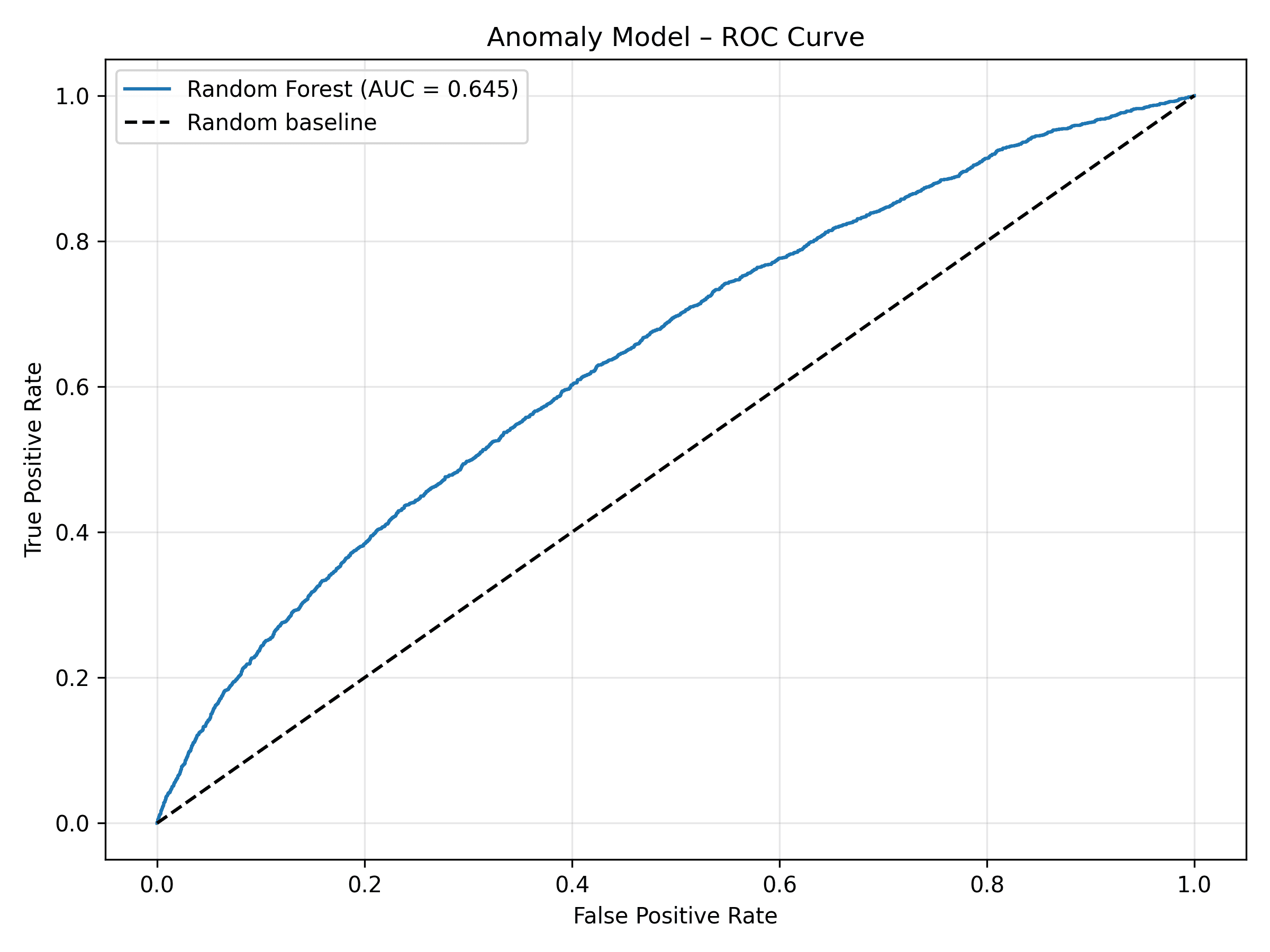
Regarding the outcomes, the esulting ROC curve shows a strong separation between normal and anomalous customers, with an AUC comfortably above random guessing.
The confusion matrix highlights the trade-off between detecting a high share of anomalies and keeping the false-positive load manageable for operations.
After training we score all customers and compute a predicted anomaly probability for each. These probabilities are then translated into:
three intuitive risk segments – low, medium and high risk
ten probability deciles – for a more granular view of risk concentration
This risk segmentation is what ultimately enables the business to prioritise investigations, adjust pricing, or tighten underwriting rules in a targeted way.